The Short Answer: Start With Your Body Weight, Twice a Week
You do not need a gym membership to build strength. For a beginner, two short sessions a week using your own body weight — squats, wall push-ups, glute bridges, and gentle core work — are enough to start. The U.S. Centers for Disease Control and Prevention (CDC) and the U.S. Department of Health and Human Services' Physical Activity Guidelines for Americans recommend that adults do muscle-strengthening activities on two or more days per week, working all major muscle groups, alongside regular aerobic activity such as brisk walking. That guideline is a public health target to work toward gradually, not a test you must pass in week one.
Strength training is simply the practice of making your muscles work against resistance. That resistance can be your body weight, a resistance band, a water bottle, or a household object. Research summarized by the National Institutes of Health (NIH) links regular muscle-strengthening activity with better muscle function, bone health, and everyday independence as people age. The point for a beginner is not lifting heavy weights or chasing soreness. It is learning a few movements well, doing them consistently, and adding a little challenge only when the current version feels comfortable.
Why Strength Matters, Even If You Already Walk
Walking is excellent — our guide to walking for health explains why — but walking alone does not fully train your muscles for the tasks of daily life. Carrying groceries, climbing stairs, getting up from a low chair, and lifting a suitcase all ask your muscles to produce force. Strength work trains exactly that. The American Heart Association (AHA) notes that resistance training is associated with better muscular fitness and can complement aerobic exercise as part of an overall active lifestyle.
There is also a confidence effect that beginners often notice first. When a squat that felt wobbly in week one feels steady in week four, everyday movement feels easier. That sense of progress is a strong motivator, and it does not require a gym, a mirror wall, or special clothes. A living room floor, a sturdy chair, and twenty minutes are enough to begin.
Before You Start: Safety Basics
Keep the first sessions gentle and short. Warm up for five minutes with easy marching in place, arm circles, and gentle leg swings. Choose movements that feel controlled, not painful. Muscle effort and mild tiredness during a set are normal; sharp pain, joint pain, or dizziness are signals to stop and rest. If you have an ongoing health condition, a recent injury, or you have been inactive for a long time, talk to a qualified health professional before starting a new exercise program. That is not a formality — it is the sensible first step, and it applies to this article's suggestions too.
Good form matters more than the number of repetitions. Move slowly, breathe normally (never hold your breath through a lift), and keep your back in a comfortable, neutral position rather than rounded or arched to an extreme. A phone video of yourself from the side, reviewed once or twice, can reveal more about your squat than any mirror. If a movement hurts a joint, change the range of motion — a shallower squat, a wall push-up instead of a floor push-up — rather than pushing through it.
What You Need (and What You Don't)
You need comfortable clothes, supportive shoes or bare feet on a non-slip surface, a mat or rug for floor work, and a sturdy chair for balance or seated exercises. You do not need dumbbells, a bench, or a fitness tracker to start. Household items can add resistance later: a backpack with a few books, a filled water bottle, or a resistance band if you already own one. Start with body weight alone for at least two weeks, so you learn the movements before you add load.
A Beginner Session You Can Do at Home
Here is a simple full-body session. Do it twice a week with at least one rest day between sessions. Rest 30 to 60 seconds between exercises, and stop a set when your form starts to break down rather than chasing a target number.
- Chair squats (8–10 reps). Stand in front of a sturdy chair, feet hip-width apart. Sit back as if sitting down, lightly touch the chair, then stand. Keep your chest up and your knees tracking over your toes.
- Wall push-ups (8–12 reps). Face a wall at arm's length, hands flat at shoulder height. Bend your elbows, bring your chest toward the wall, and press back. Step further from the wall to make it harder.
- Glute bridges (10–12 reps). Lie on your back, knees bent, feet flat. Press through your heels to lift your hips, pause briefly, and lower slowly.
- Dead bugs (6–8 per side). Lie on your back, arms toward the ceiling, knees bent at 90 degrees. Slowly extend one arm and the opposite leg, then return. Keep your lower back gently pressed toward the floor.
- Standing calf raises (10–15 reps). Hold a chair for balance, rise onto your toes, pause, and lower slowly.
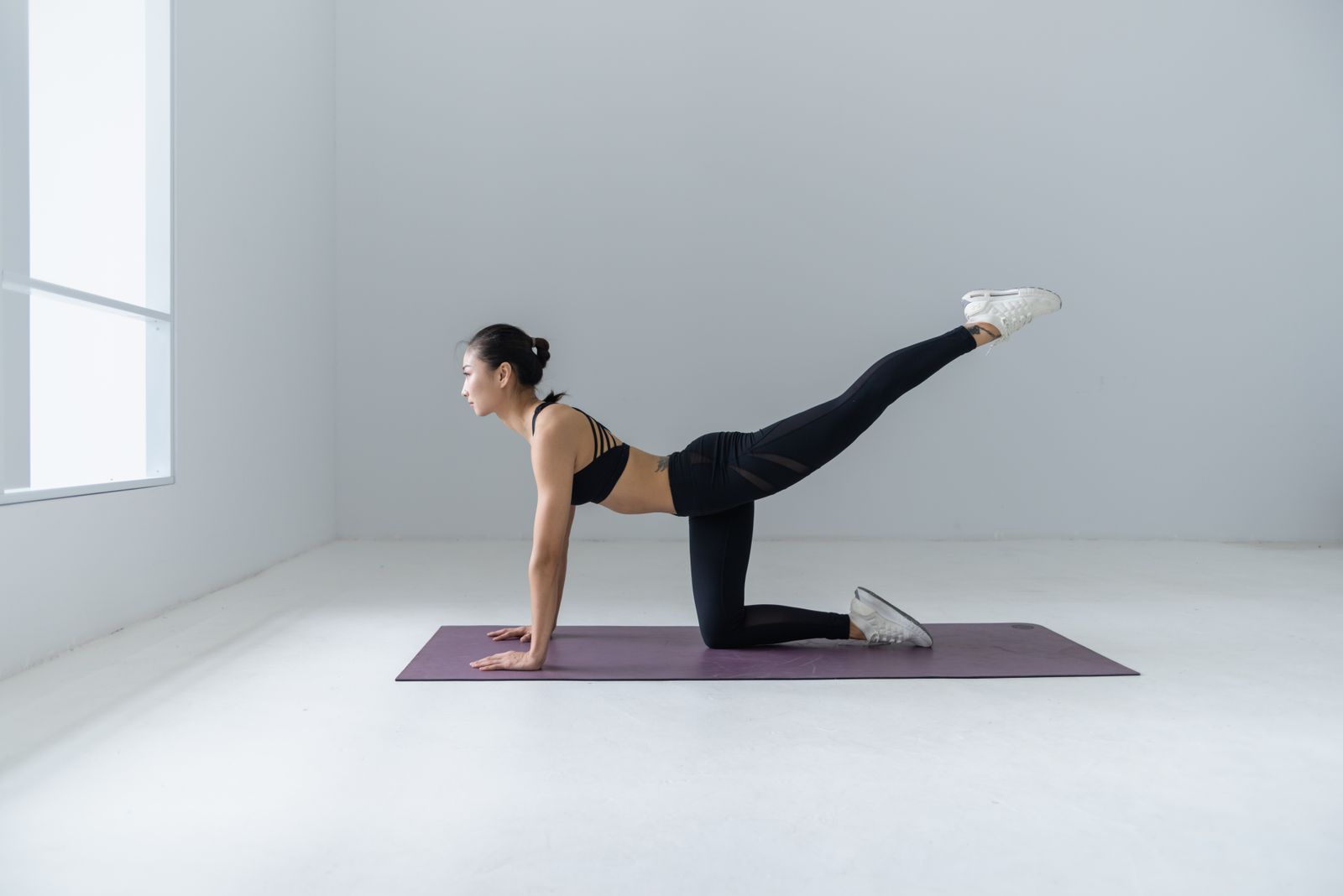
- Bird dogs (6–8 per side). On hands and knees, extend one arm and the opposite leg, hold briefly, and return. Keep your hips level.
That whole circuit takes about 20 minutes, and doing it twice through is plenty for a first month. The CDC's guidance of two days a week is a goal to build toward, so if one session a week is what fits your life right now, start there and add the second session when it feels manageable. Consistency over months beats intensity over days, and a routine you keep is worth more than a routine you dread.
How to Progress Without a Gym
Progress in strength training means gradually making a movement a little harder. The classic approach is to add repetitions first, then slow the movement down, then change the leverage, and only then add weight. For example, a wall push-up becomes a countertop push-up, then a knee push-up on the floor, then a full push-up — each step is a real achievement, and each may take weeks. A chair squat becomes a free squat, then a slower squat with a three-second lowering phase, then a squat holding a backpack.
Track your sessions in a notebook or a notes app: the date, the exercises, and the repetitions. Seeing the numbers climb over a month is motivating, and it stops you from guessing whether you are improving. If a session feels too easy — you could have done five more reps with good form — that is the signal to move to the next variation. If it feels hard but doable, stay at that level for another week or two. Strength adapts on a scale of weeks, not days, so patience is part of the program.
Rest and Recovery
Muscles adapt during rest, not during the workout itself, which is why the guidelines suggest spacing strength sessions across the week rather than stacking them on consecutive days. Mild muscle soreness a day or two after a new session is common and usually fades. Sleep, regular meals, and water all support recovery, and they connect directly to the other habits on this blog: our sleep hygiene basics guide and our balanced breakfast guide both support the same goal of steady, sustainable energy. If soreness is severe, lasts more than a few days, or comes with swelling or sharp pain, rest and seek advice rather than training through it.
Common Beginner Mistakes
The most common mistake is starting too hard. A first session that leaves you barely able to sit down the next day is not a badge of honor; it is a reason many people quit. Start at about half of what you think you can do, and finish feeling like you could have done a little more. The second mistake is skipping the warm-up and cool-down. Five minutes of gentle movement at the start and a few slow stretches at the end reduce stiffness and make the session feel better. The third is comparing yourself to online videos. Fitness content often shows advanced versions performed by experienced people. Your workout only needs to suit your body, your space, and your week.
Another trap is the all-or-nothing mindset. A missed session is not a failed program. If you planned two sessions and managed one, you still trained. The research on habit formation consistently shows that returning after a missed day matters more than never missing one. Keep your mat visible, your session short, and your expectations realistic, and the habit has room to survive a busy week.
A Four-Week Starter Plan
Week one is about learning. Do the circuit once, twice in the week, at the easiest variation, and focus on form. Week two, repeat the same session but add two repetitions to each exercise if your form stays clean. Week three, do the circuit twice through on each session day, with a short rest between rounds. Week four, move one exercise to its next variation — wall push-ups to countertop push-ups, for example — and keep the rest the same. By the end of the month you will have a genuine baseline, and you will know which movements you enjoy and which need more practice.
After that first month, you can add variety slowly. A resistance band, a step, or a pair of light household weights can open up new variations, but none of them is required. You can also pair strength days with walking days: strength on Monday and Thursday, a walk on Tuesday, Saturday, or any day that fits. Our walking guide and our early mornings guide both fit this rhythm, since a morning session is easier to protect from a busy evening.
Frequently Asked Questions
How long should a beginner strength session take?
About 20 to 30 minutes, including a warm-up. Shorter sessions done consistently are more useful than long sessions done rarely, especially in the first month.
Do I need to feel sore for it to work?
No. Mild soreness after a new movement is common, but it is not required for progress. Steady effort with good form, repeated over weeks, is what builds strength.
Can I do strength training every day?
Beginners do better with rest days between sessions for the same muscle groups. Two or three sessions a week, spaced out, is the standard recommendation from the CDC and the Physical Activity Guidelines for Americans.
What if I cannot do a full push-up or squat?
Use an easier variation. Wall push-ups and chair squats are real strength exercises, not lesser versions. Progress comes from moving to harder variations gradually, not from struggling with a version you cannot control.
Should I buy equipment before I start?
No. Start with body weight for at least two weeks. If you still enjoy the routine, a resistance band or light household weights can add variety later — but they are optional, not a starting requirement.
Disclaimer: This article is for general information only and is not medical advice. Talk to a qualified health professional about your own situation.



0 Comments
Play nice — spam and promo links are deleted.